Home>
Industry News>
If graphene is embedded in aluminum profiles, can it improve both strength and thermal conductivity? What are the technical difficulties?
If graphene is embedded in aluminum profiles, can it improve both strength and thermal conductivity? What are the technical difficulties?
2025,04,09
Yes, embedding graphene into aluminum profiles can simultaneously enhance both strength and thermal conductivity. Here's the technical analysis and challenges:
1. Strength Enhancement
Graphene's exceptional mechanical properties (theoretical tensile strength ~130 GPa) enable significant reinforcement of aluminum matrices. Studies show graphene-aluminum composites achieve 30-80% higher tensile strength than pure aluminum. The key mechanisms include:
Load transfer: Graphene's 2D structure effectively transfers stress across the aluminum matrix.
Grain refinement: Graphene inhibits dislocation movement, refining aluminum's microstructure.
2. Thermal Conductivity Improvement
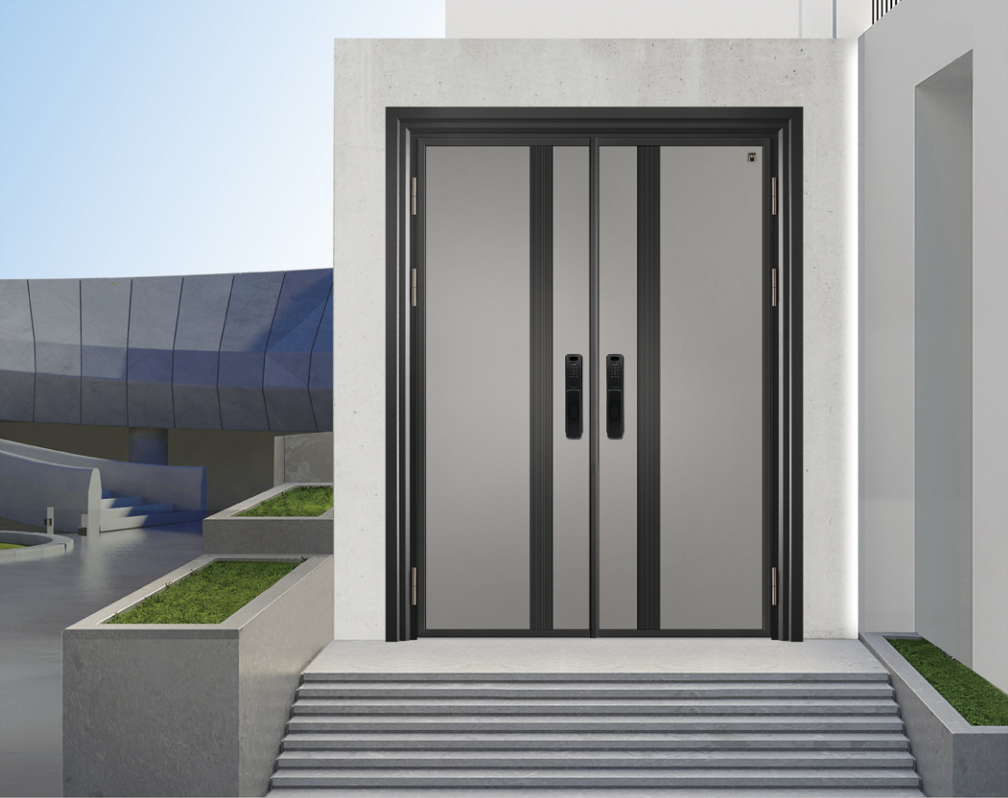
Graphene's ultrahigh in-plane thermal conductivity (~5,300 W/m·K) enables aluminum composites to achieve 50-300% higher thermal conductivity. Applications like Entrance Door frames benefit from rapid heat dissipation, while Villa Door systems gain energy efficiency via improved thermal management. However, out-of-plane conductivity remains limited by interfacial phonon scattering.
Technical Challenges
a) Uniform Dispersion: Graphene tends to aggregate due to van der Waals forces, causing localized stress concentrations. Solutions like ball milling or chemical functionalization are energy-intensive and may damage graphene's structure.
b) Interfacial Bonding: Weak graphene-Al bonding reduces load/heat transfer efficiency. Uncontrolled Al formation at interfaces (500-600°C) degrades mechanical properties. Plasma-enhanced CVD or Ni/Ti coatings improve adhesion but increase costs.
c) Scalable Manufacturing: Current methods (e.g., melt stirring, powder metallurgy) struggle to align graphene sheets optimally. Pressure infiltration achieves 85-95% density but requires precise temperature/pressure control.
d) Cost-Effectiveness: High-quality graphene production and composite processing remain expensive, limiting adoption in mass-produced Room Door components.
Future Directions
Hybrid architectures combining graphene with CNTs or diamond particles for synergistic strengthening.
AI-driven process optimization to balance graphene content (0.5-5 wt%), alignment, and interfacial design.
In summary, while graphene-aluminum composites show transformative potential for high-performance doors (Entrance Door, Room Door, Villa Door), overcoming dispersion, interfacial, and scalability barriers remains critical for industrial adoption.
Contact Us


Popular Products
Company News
2024 Continue Your Light Luxury Road
September 18, 2024

Industry News
You may also like
Related Information
Related Categories
Email to this supplier
Contact Us
Popular Products
Company News
2024 Continue Your Light Luxury Road
September 18, 2024
Industry News